
In today’s Shopify and eCommerce world, traffic alone does not guarantee sales. Shoppers are skeptical, ad fatigue is real and conversion depends on one thing: trust.
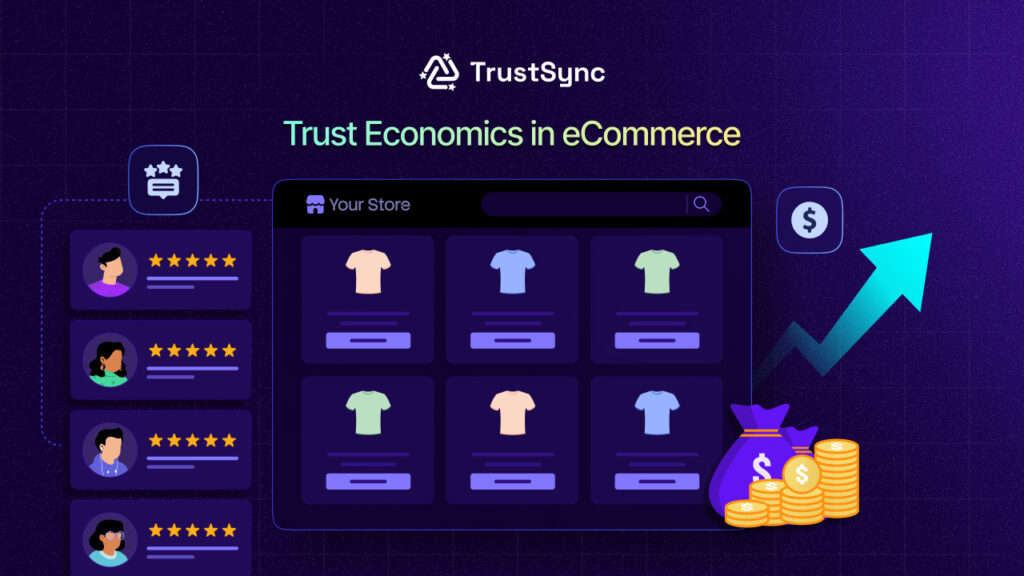
This is where trust economics comes in: the principle that credibility drives revenue more effectively than paid campaigns. Reviews, ratings and social proof reduce hesitation, increase average order value and turn first-time visitors into loyal customers. In this blog, we explore why building trust is the most profitable strategy for online stores today.
TL;DR:
In eCommerce, traffic alone does not guarantee revenue. Trust economics shows that reviews, ratings and social proof are more effective than ads at boosting conversions, increasing average order value and encouraging repeat purchases. Shopify stores that prioritize trust reduce risk for shoppers, build long-term credibility and create sustainable revenue growth. Tools like TrustSync can automate review collection and make implementing trust economics easy. Build trust assets, not just ad campaigns, to grow your online store profitably.
The Shift from Attention Economy to Trust Economics at a Glance
For years, eCommerce growth was dominated by the attention economy, the idea that whoever captures the most eyeballs wins. Brands poured budgets into Facebook ads, Google Shopping campaigns, influencer promotions and display networks to drive traffic to their Shopify or online store.
But the landscape has changed. Customer acquisition costs are rising. Consumers are more skeptical. Ad fatigue is real. Visibility alone no longer guarantees conversions. In fact, traffic without trust often leads to high bounce rates, abandoned carts and wasted ad spend.
This is where trust economics becomes the new competitive advantage. Instead of competing purely for attention, modern eCommerce brands compete for credibility. And credibility compounds. A store with strong reviews, visible social proof and authentic customer validation converts better with less traffic.
Defining Trust Economics in eCommerce
What is trust economics? Let us learn about it first. Trust economics is the principle that trust is more than just a branding element; it is a measurable economic asset that directly impacts revenue performance. In eCommerce, trust influences key business metrics such as conversion rates, average order value (AOV), customer lifetime value (CLV), repeat purchase behavior and even cart abandonment rates. Essentially, trust directly affects how much revenue your online store can generate.
When shoppers visit a Shopify store for the first time, they immediately assess risk. Questions like “Is this store legitimate?” and “Are the reviews authentic?”, “Will I receive what I ordered?” and “What happens if something goes wrong?” run through their minds. These evaluations determine whether they proceed with a purchase or abandon the cart.
Trust economics works by reducing this perceived risk. The lower the uncertainty, the higher the likelihood of a sale. Every positive signal, from genuine reviews to transparent policies, compounds trust, making customers feel confident and more willing to buy. In this sense, trust is not abstract; it directly translates into tangible financial outcomes for your online store.
How Trust Functions as a Revenue Multiplier
According to customer statistics, customer reviews can boost your online sales by 270%. Trust acts as a revenue multiplier across your entire growth equation:
Revenue = Traffic × Conversion Rate × Average Order Value × Repeat Purchases
Most brands obsess over increasing traffic through ads. But traffic alone does not guarantee profitability.
Trust improves the other three variables:
- Higher Conversion Rates: When customers see strong reviews and social proof, they feel confident clicking “Buy Now.”
- Increased Average Order Value: Trust reduces hesitation around higher-priced products and add-ons.
- Stronger Repeat Purchase Behavior: Customers return to stores they trust. Trust lowers the mental barrier for future purchases.
This means that even if your traffic stays constant, improving trust can significantly increase revenue. Unlike ads, which require continuous spending, trust compounds over time. Every positive review strengthens your store’s credibility, making future conversions easier and less expensive.
Read more 👉Ultimate Guide to Building Customer Trust on Shopify with TrustSync
The Difference Between Traffic Growth vs Trust Growth
Understanding the distinction between traffic growth and trust growth is critical for long-term eCommerce success. A traffic growth strategy focuses on acquiring new visitors, often through paid ads, promotions or influencer campaigns. While it can generate immediate spikes in site visits, it requires continuous budget allocation and ROI often declines as competition increases. Simply put, more traffic does not guarantee more sales if visitors do not feel confident about your store.
On the other hand, a trust growth strategy focuses on building credibility and reputation. This approach relies on customer reviews, social proof and transparent practices to reduce uncertainty. Unlike ad campaigns, trust growth reduces dependency on paid acquisition and creates compounding returns over time. Every positive review, rating or testimonial strengthens your store’s reputation, increasing the likelihood of purchase and fostering long-term loyalty.
In practice, a Shopify store running aggressive ads may see many visitors, but without visible trust signals, conversion rates remain low. Conversely, a store with strong customer validation can outperform competitors even with lower ad spend because visitors immediately feel confident purchasing. Traffic creates opportunity; trust converts opportunity into revenue. This shift from chasing attention to building credibility embodies the core principle of trust economics in eCommerce.
Here is the summary of traffic growth vs trust growth for you.
| Factor | Traffic Growth | Trust Growth |
| Primary Goal | Increase visitor volume | Increase conversion confidence |
| Core Strategy | Paid ads, promotions, influencer campaigns | Reviews, ratings, social proof, customer validation |
| Cost Structure | Continuous and rising ad spend | Low cost after initial systems are set |
| Revenue Impact | Indirect (depends on conversion rate) | Direct (improves conversion rate, AOV, CLV) |
| Sustainability | Short-term and campaign-dependent | Long-term and compounding |
| Risk Level | High if ads stop performing | Lower due to built credibility |
| Competitive Advantage | Easily replicated by competitors | Harder to replicate (reputation-based) |
| ROI Pattern | Linear (spend more to earn more) | Exponential (trust compounds over time) |
Why Reviews Power Trust Economics?
In eCommerce, reviews are not just feedback; they are revenue-generating assets. Customer reviews and testimonials serve as social proof, validating your products and store in the eyes of new visitors. In today’s competitive Shopify and online store landscape, reviews help reduce hesitation, build trust and ultimately drive revenue more effectively than paid ads.
Let us break down how reviews directly power trust economics.
Reviews Reduce Perceived Purchase Risk
When shoppers browse an online store, they subconsciously weigh risk: Will this product meet my expectations? Is the store reliable? Will I get support if something goes wrong? Positive reviews act as a shortcut to answer these questions. They reassure buyers that others have successfully purchased the product, received it on time and had a good experience. By reducing perceived risk, reviews make it easier to click “Buy Now,” boosting overall purchase confidence.
Reviews Increase Conversion Rates
The most direct impact of reviews is on conversion rates. Numerous studies show that products with even a handful of reviews convert significantly better than products with none. Authentic customer feedback demonstrates credibility and helps potential buyers overcome doubts, resulting in more completed transactions. For Shopify stores, integrating reviews strategically on product pages, collection pages and checkout pages ensures that visitors encounter trust signals at critical decision points.
Reviews Boost Average Order Value (AOV)
Trust also influences how much customers are willing to spend. When shoppers trust your store, they feel comfortable purchasing higher-ticket items or adding complementary products to their cart. Reviews, especially detailed ones that highlight product features, benefits and use cases, reduce hesitation and justify larger purchases. In this way, reviews directly contribute to increasing the average order value without additional marketing spend.
Reviews Improve Repeat Purchases & Customer Loyalty
Trust does not stop at the first sale. Reviews foster a sense of credibility that encourages repeat purchases and long-term loyalty. Customers are more likely to return to a store where previous buyers have shared positive experiences. Responding to reviews for both positive and negative further strengthens trust, showing that your Shopify store values transparency and cares about customer satisfaction. Over time, these interactions build a loyal customer base that drives consistent revenue.
Reviews Strengthen SEO And Organic Visibility
Beyond conversions and loyalty, reviews are a hidden SEO asset. User-generated content naturally enriches product pages with keywords, unique phrasing and fresh content, improving search engine rankings. Star ratings can appear as rich snippets in Google search results, enhancing click-through rates. For online stores, reviews not only convince customers but also attract organic traffic, creating a compounding effect: more visibility → more trust → more revenue.
Trust Economics vs Paid Advertising: A Direct Comparison
Many online store owners default to paid advertising as the primary growth driver. While ads can generate immediate traffic, trust economics emphasizes that credibility and customer validation often produce more sustainable revenue. One recent industry overview reports that 88% of consumer buying decisions are influenced by trust, with consumers relying on trusted sources and signals (like reviews, reputation, and validation) far more than traditional ads when choosing whether to purchase. Comparing these two strategies reveals why reviews and social proof can outperform ad campaigns over time.
Cost Structure Comparison
Paid advertising requires continuous spending; every click, impression or campaign costs money. The moment you stop investing, traffic and conversions drop. In contrast, trust-driven strategies, like collecting reviews and showcasing social proof, involve minimal ongoing costs once set up. Each new review adds value without additional spending, creating a durable, compounding asset. Over time, the cost efficiency of trust growth far exceeds that of ads, especially for Shopify stores looking to maximize profitability.
Short-Term ROI vs Long-Term Compounding ROI
Ads deliver short-term ROI: traffic spikes while campaigns run, but results quickly diminish once budgets are exhausted. Trust-driven growth works differently. Positive reviews, testimonials and visible customer validation continue to influence new visitors long after they are posted. This generates long-term, compounding ROI, as trust builds over time, increasing conversions, average order value and repeat purchases without extra ad spend. Simply put, ads provide a temporary boost, while trust multiplies revenue steadily.
Credibility Gap: Brand Messaging vs Customer Proof
Paid ads rely on brand-controlled messaging, which shoppers know is inherently promotional. This often creates a credibility gap: visitors see the marketing but may hesitate to act. Trust economics bridges that gap through customer proof. Authentic reviews, ratings and social proof carry far more weight because they come from impartial voices. When shoppers see real people endorsing products, they feel reassured and confident. The credibility gained through trust is not just persuasive; it directly converts traffic into revenue.
A quick comparison of trust economics vs paid advertising for you.
| Factor | Paid Advertising | Trust Economics |
| Cost Structure | Continuous spend required; stops delivering if budget stops | Low ongoing cost; value compounds with each review or testimonial |
| ROI Pattern | Short-term; depends on active campaigns | Long-term, trust compounds over time, increasing revenue steadily |
| Credibility | Brand-controlled messaging; inherently promotional | Customer-generated proof; independent and highly persuasive |
| Revenue Impact | Traffic-focused; indirect influence on conversions | Conversion-focused; directly improves sales, AOV, repeat purchases |
| Sustainability | Campaign-dependent; temporary spikes | Asset-based; builds permanent competitive advantage |
| Competitive Advantage | Easily replicated by competitors | Harder to replicate; based on reputation and social proof |
Why Trust Economics Matters Even More for Shopify Stores
Shopify has made it easier than ever to launch an online store. While this democratizes eCommerce, it also creates a highly competitive landscape. In this environment, trust economics becomes a critical factor for standing out and driving sustainable revenue. Let us explore the compelling reasons for emphasizing trust economics in your Shopify store.
Low Barrier to Entry = High Competition
The simplicity of setting up a Shopify store means that thousands of new stores launch every day, often selling similar products. While traffic generation strategies may temporarily drive attention, they rarely provide a lasting advantage. Trust becomes the differentiator. Stores that showcase genuine reviews, ratings and testimonials immediately signal credibility, helping shoppers feel confident choosing their products over competitors’, even in crowded markets.
Differentiation Through Social Proof
Social proof is one of the most effective ways for Shopify stores to differentiate themselves. When visitors see other customers vouching for a product, it creates instant credibility. This goes beyond just having a nice website or running paid ads; it is authentic validation from real users. Customer photos, detailed reviews and star ratings communicate trust and reliability, setting your store apart from competitors relying solely on advertising or promotional messaging.
Building Brand Equity Through Reviews
Reviews do not just improve immediate sales; they build long-term brand equity. Every positive review strengthens the perception that your Shopify store is reliable, professional and customer-focused. Over time, this reputation becomes a self-reinforcing asset: more trust leads to more purchases, more reviews and even stronger SEO performance. In other words, investing in trust economics doesn’t just drive short-term revenue; it cultivates a sustainable competitive moat for your online store.
How to Implement Trust Economics in Your Online Store?
Building trust economics in your Shopify store is not just about asking for reviews; it’s about creating systems that consistently capture, showcase and act on customer feedback. Here’s how you can implement trust-driven growth strategies effectively.
Step 1: Automating Review Collection for Shopify Store
Manually requesting Shopify reviews is time-consuming and often inconsistent. Automating review collection ensures that every customer has an opportunity to leave feedback. Tools like TrustSync, a Shopify review request app, make it easy to send timely, personalized email requests after a purchase. By automating this process, you not only increase the volume of reviews but also maintain consistency, turning customer feedback into a continuous growth engine for your store.
Step 2: Displaying Reviews on Product Pages, Review Platforms, etc
Where you place your Shopify reviews matters. Displaying reviews prominently on product pages, collection pages and near “Add to Cart” buttons maximizes their impact. Highlight star ratings, customer photos and detailed testimonials to reduce hesitation at the point of purchase. The more visible and accessible your social proof, the stronger the trust signals, helping potential buyers convert with confidence.
Additionally, you should focus on improving your brand’s perception by obtaining reviews on sites like Google, TrustPilot, G2 and others. Your credibility will increase as a result. The TrustSync app can help you get useful reviews on a variety of review platforms.
Step 3: Leveraging Google Reviews for Broader Trust
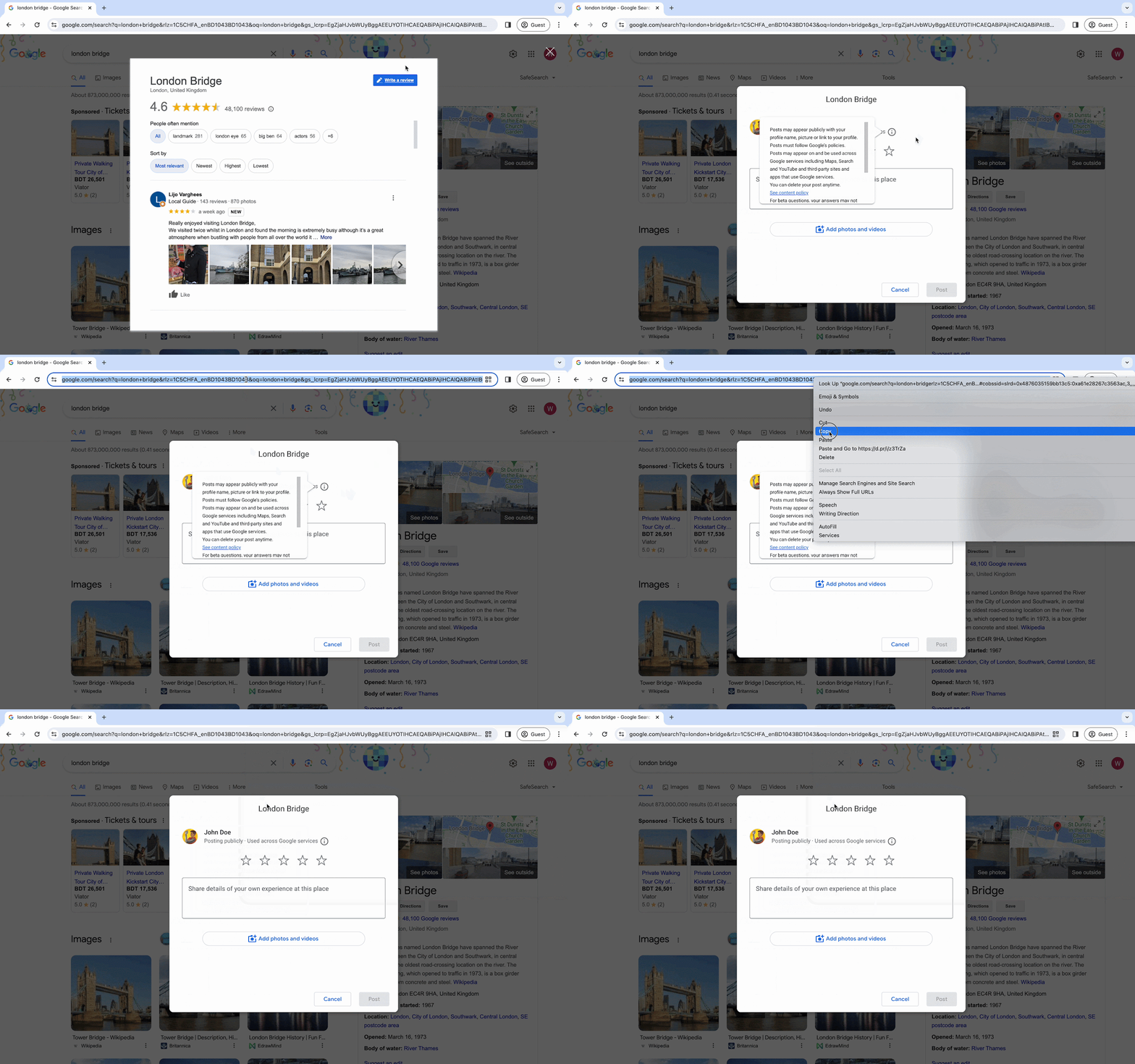
Customer reviews should not just live on your Shopify store. Google Reviews enhance your brand’s credibility in search results, improve click-through rates and provide a sense of legitimacy to new visitors. By integrating these reviews with your store or even displaying them on your homepage, you extend the impact of trust beyond your website and reach a broader audience.
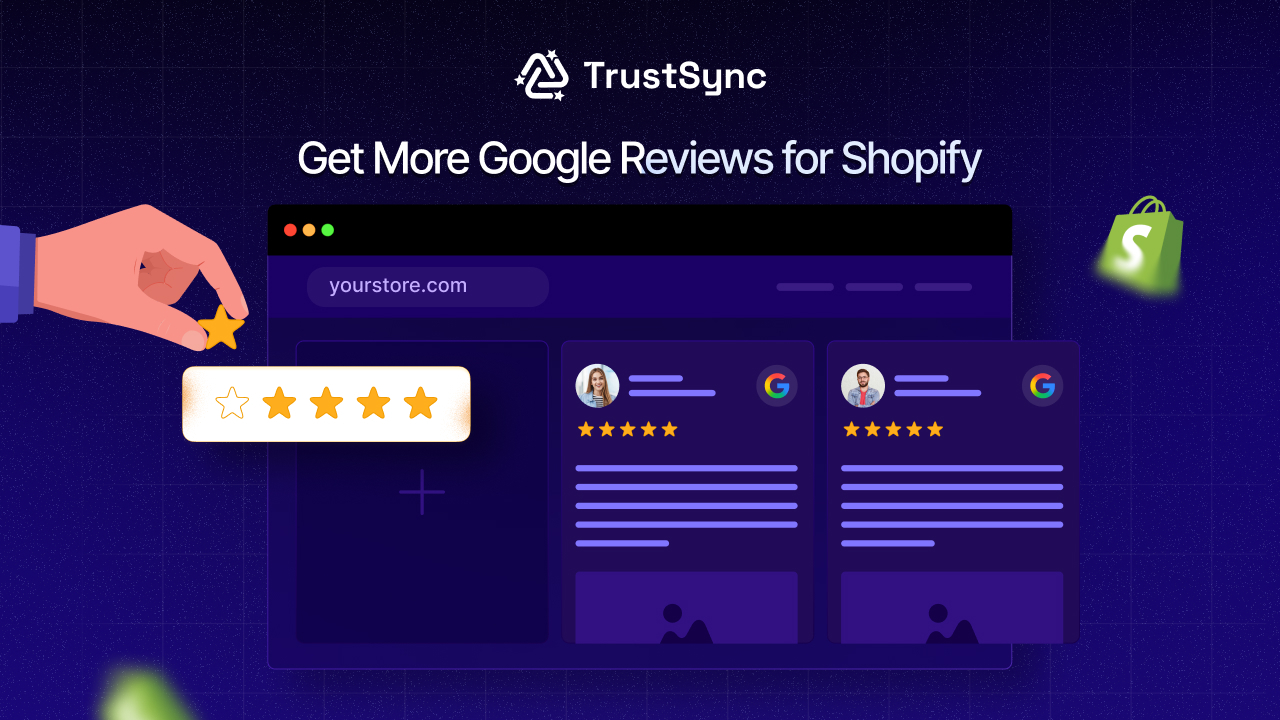
Check out 👉 How to Get More Reviews for Your Shopify Store
Step 4: Responding to Negative Reviews to Build Transparency
No store is perfect and negative reviews will happen. Responding thoughtfully and professionally demonstrates transparency and commitment to customer satisfaction. A well-handled negative review can increase trust more than a positive one, showing shoppers that your store values feedback and resolves issues.
ThustSync can help you here. When a customer intends to provide a lower rating, TrustSync will immediately direct them to your dashboard and facilitate a dedicated feedback dialogue between both parties. In this manner, you can increase positive feedback and decrease negative ratings.
For Your Business, Build Trust Assets, Not Just Ad Campaigns
In today’s eCommerce world, ads can bring traffic, but trust converts it into revenue. Reviews, social proof and authentic customer validation are not just marketing tools, they are assets that grow your Shopify store over time. Investing in trust economics ensures long-term profitability, repeat customers and a strong brand reputation that ads alone cannot deliver.
Start building your trust assets today and stay ahead of the competition. Subscribe to our blog for more actionable insights and strategies to grow your online store sustainably.
FAQ
1. What is Trust Economics in eCommerce?
Trust economics is the idea that customer trust is a measurable asset that directly affects revenue. In online stores, trust boosts conversions, average order value, repeat purchases and reduces cart abandonment.
2. Why are reviews more effective than ads?
Reviews provide authentic social proof, reduce purchase hesitation and build credibility. Unlike ads, which stop working when you stop spending, reviews compound value over time.
3. How can Shopify stores collect more reviews?
Automating review requests after purchase is the easiest way. Apps like TrustSync can send timely, personalized emails, increasing the number and quality of reviews without manual effort.
4. Do reviews improve SEO for online stores?
Yes. Customer reviews add fresh, user-generated content and keywords to your product pages, improving search visibility and click-through rates on Google.
5. How do negative reviews affect my store?
Handled properly, negative reviews build trust. Responding professionally shows transparency, reassures potential buyers and can even strengthen your store’s credibility.