
Getting customer reviews should not feel like chasing shadows, yet for many businesses, it does. You deliver a great product or service, the customer walks away happy and then there is silence. No feedback, no testimonial, no social proof. The missing link is often a well-created review request email template that actually gets opened, read and acted on.
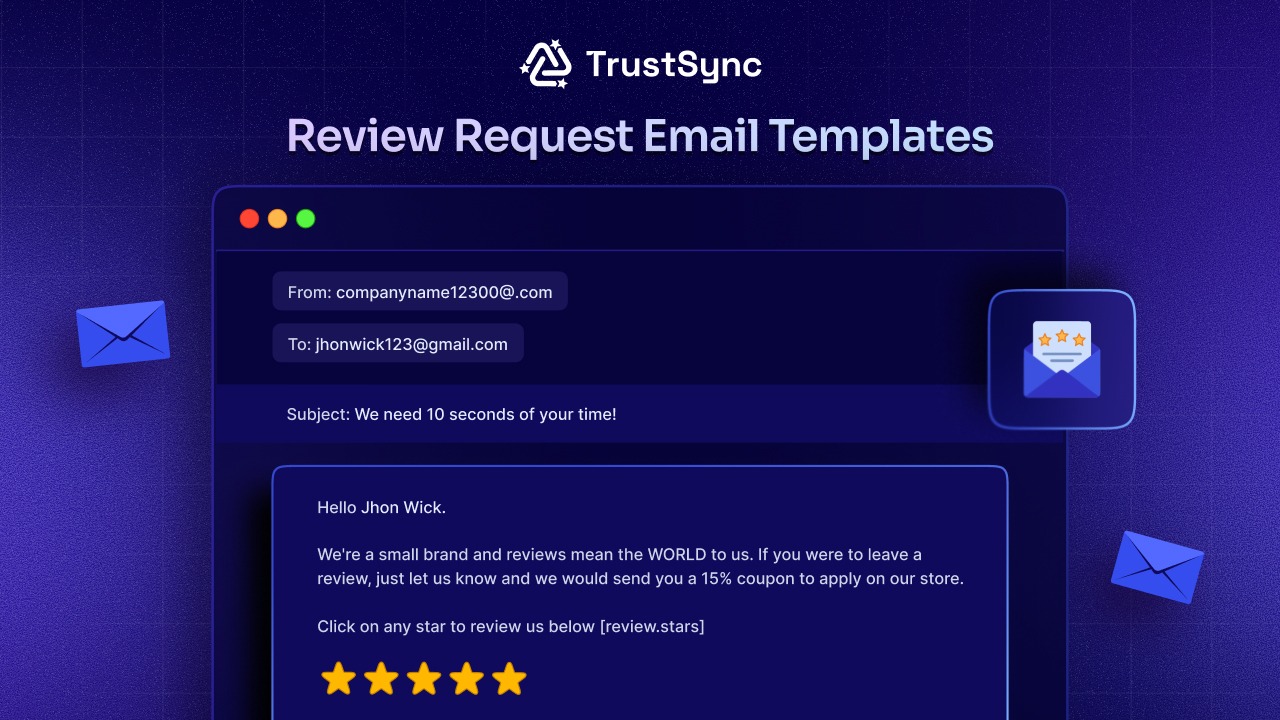
That is why having the right review request email template matters. Instead of starting from scratch every time, you can use proven formats that encourage responses while staying true to your brand voice.
In this blog, you will find 10+ outstanding review request email templates designed for different scenarios, from post-purchase follow-ups to service-based feedback requests. For businesses like an eCommerce store, SaaS, an agency and more, these templates will help you turn satisfied customers into loyal advocates with minimal effort.
Quick Summary / TL;DR
Everything you need to know in 90 seconds
- Why it matters: According to research, 74% of consumers look at multiple review sites before buying. Online reviews displayed on a website can boost conversions by up to 270%. Yet most businesses never ask for a review.
- The ask matters: Sending a well-timed, personalised review request email is the single most effective way to grow your review count. Studies show confirmation/post-purchase emails are 2x–5x more effective than bulk campaigns.
- What this blog covers: 10+ ready-to-use review request email templates spanning every scenario: post-purchase, follow-up, Google review, loyalty, product-specific, incentive, re-engagement, B2B, and more.
- Key best practices: Send at the right time (7–14 days post-delivery for physical products), personalise with the customer’s name and product, keep emails short, use a single clear CTA, and always send from a real domain.
- TrustSync advantage: TrustSync’s Review Request Email feature lets Shopify stores automate all of this: custom design, domain sending, bad-review filtering, analytics and 10+ built-in templates and more without writing a single line of code.
Why Review Request Emails Are Non-Negotiable in 2026?
Every purchase is an opportunity. Not just for revenue but for reputation. A satisfied customer who completes a transaction and walks away without leaving a review is a missed asset. And in the competitive landscape of eCommerce today, reputation is currency.
The data make this undeniable. Displaying customer reviews on a website can increase conversions by 270%. Meanwhile, 74% of consumers check multiple review sites before making a purchasing decision. For Shopify brands, this means every 5-star review is doing active selling work long after the original purchase.
The problem is simple: most happy customers do not spontaneously leave reviews. They need to be asked. And how you ask (the timing, the tone, the personalization, the simplicity) determines whether you collect that review or whether it slips away forever.
A well-created review request email is your most reliable tool. Unlike social media posts or in-store requests, email reaches your customer at the right moment, on their terms, with a direct path to action. Done right, it feels like a warm, personal touch rather than a marketing blast.
This blog gives you 10+ outstanding templates, a strategic framework, and the tools to automate the whole process. Let us build your review engine.
The Anatomy of a High-Converting Review Request Email
Before diving into the templates, it helps to understand what separates a review email that gets ignored from one that gets results. Every high-performing review request email shares six structural elements.
| Element | What makes it work |
|---|---|
| Subject Line | Under 50 characters; personalised with name or product; avoids spam triggers; creates curiosity or states clear value. |
| Opening | Warm greeting using the customer’s first name. Reference their specific purchase to signal this is not a generic blast. |
| Body Copy | Short. 3–5 sentences maximum. Remind them of the experience, explain why the review matters, and make it feel human. |
| Call to Action | One CTA only. A prominent button with action-oriented text: “Leave a Review”, “Share Your Experience”, “Rate Your Order”. |
| Social Proof Hook | Optional but powerful: mention how many reviews you’ve already received or show a star-rating to set expectations. |
| Sender Details | Always send from a real, branded email address — not no-reply@. Sign with a real name to build trust. |
The Golden Rule: Shorter Emails Convert Better
Research consistently shows a clear inverse relationship between email length and conversion rate. Every extra sentence is another reason to click away. Imagine each word costs you $100, then write accordingly. Your goal is to get the customer to the review page, not to write a newsletter.
Getting the Timing Right: When to Send Your Review Request
Timing is arguably the single biggest lever in review request performance. Send too early and the customer has not experienced the product. Send too late and enthusiasm fades. Here’s the framework:
| Business Type | Optimal Send Time | Reason |
|---|---|---|
| Fashion & Apparel | 7 days post-delivery | Enough time to wear and form an opinion |
| Skincare & Beauty | 21 days post-delivery | Products need time to show results |
| Electronics & Tech | 10–14 days post-delivery | Setup and usage time needed |
| Food & Consumables | 2–3 days post-delivery | Experience is immediate |
| Services & SaaS | Immediately after completion | While the experience is freshest |
| Restaurants & Events | Within 24 hours | Memory is strongest right after |
12 Outstanding Review Request Email Templates
Each template below is copy-ready. Replace the bracketed placeholders with your brand details and product information. Notes after each explain the psychology and when to deploy it.
i. The Classic Post-Purchase Ask
The simplest and most deployed template. Clean, friendly, and direct — this works across virtually every product category.
Template #1: Classic Post-Purchase Ask
| Subject Line: How did we do, [First Name]? ⭐Hi [First Name], Thank you so much for your recent order of [Product Name] — we hope it’s everything you expected and more! We’d love to hear about your experience. Would you mind taking 60 seconds to leave us a quick review? Your feedback helps other shoppers like you make confident decisions — and it means the world to our small team. [LEAVE A REVIEW →] Thank you for being an amazing customer!Warm regards,[Your Name] at [Brand Name] |
Why it works:
- Personalised subject line with emoji increases open rates
- References the specific product to create immediate recall
- Quantifies the time investment (60 seconds) to reduce friction
- Explains the social value (helping other shoppers) rather than just asking for a favour
- Signs off warmly with a real name — not ‘The Team.’
ii. The Gratitude-First Approach
Lead with appreciation before making any ask. This is particularly effective for small brands, artisan sellers, and businesses built on personal connection.
Template #2: Gratitude-First
| Subject Line: A personal thank-you from us, [First Name]Hi [First Name], We just wanted to take a moment to sincerely thank you for choosing [Brand Name]. With so many options out there, your trust genuinely means a lot to us. We’re a small team, and every order — including yours for [Product Name] — is something we truly care about. If you’ve had a chance to enjoy your purchase, we’d be incredibly grateful if you could share your experience with a quick review. It takes just a moment and helps us continue doing what we love. [Share Your Experience →] With gratitude,[Your Name], Founder at [Brand Name] |
Why it works:
- Emotional reciprocity: customers who feel appreciated are psychologically inclined to reciprocate
- ‘Small team’ framing creates a human connection and sense of personal stakes
- The ask comes after the emotional foundation is set — never feels transactional
- Signing from a founder builds authenticity and trust
iii. The Google Review Request
Google reviews directly impact your local SEO rankings and business visibility. Use this template when you want to drive reviews specifically to your Google Business Profile.
Template #3: Google Review Request
| Subject Line: [First Name], would you help us on Google? 🌟 Hi [First Name], We hope your [Product Name] has been treating you well! We’d love to ask a small favour. If you’ve been happy with your experience, could you leave us a quick Google review? Google reviews help customers find us and help us keep doing what we do best. It takes less than 2 minutes, and we genuinely read every single one. [Leave a Google Review →](This link takes you directly to our Google review page — no searching required.) Thank you so much![Your Name] at [Brand Name] |
Why it works:
- Names Google explicitly — customers know exactly where they’re going, reducing drop-off
- Direct link removes all friction (no searching for the Google page)
- ‘We read everyone’ makes the customer feel heard and valued
- 2-minute framing sets a low time expectation
iv. The Follow-Up Nudge (Second Email)
For customers who opened the first email but didn’t click, a single well-timed follow-up can capture reviews that would otherwise be lost. Send this 5–7 days after the first email.
Template #4: Follow-Up Nudge
| Subject Line: Still got a minute, [First Name]? ⏰ Hi [First Name], We reached out a few days ago to ask about your [Product Name], and we completely understand if life got busy! We just wanted to send a gentle reminder — your review really does make a difference to us and to shoppers looking for honest feedback. If you have two minutes today, we’d love to hear from you. [Leave Your Review →] No pressure at all, and thank you either way for being a valued customer! Best,[Your Name] |
Why it works:
- Acknowledges the previous email without being passive-aggressive
- ‘Life got busy’ gives the customer a graceful excuse — removes guilt and resistance
- ‘No pressure’ paradoxically increases compliance by removing perceived obligation
- Keeps it shorter than the first email — respects their time even more
v. The Incentive-Based Review Email
Offering an incentive for leaving a review significantly increases response rates. Note: Only use incentives for reviews on your own site or platforms that permit it. Google, Yelp, and Trustpilot prohibit incentivised reviews.
Template #5: Incentive-Based Review
| Subject Line: A thank-you gift for sharing your thoughts, [First Name] 🎁 Hi [First Name], How are you loving your [Product Name]? We hope it’s exceeded your expectations! As a small token of our appreciation, we’d like to offer you 15% off your next order when you share a review of your recent purchase. Simply leave your honest feedback at the link below, and your discount code will be emailed to you automatically. [Share Your Review & Get 15% Off →] We truly value your opinion — good or constructive — and we read every review personally. Thank you![Your Name] at [Brand Name] |
Why it works:
- Incentives consistently deliver higher open rates — especially when ‘gift’ or a discount appears in subject line
- ‘Honest feedback’ framing signals you want genuine reviews, not just praise — builds credibility
- Automatic discount delivery reduces perceived effort
- Important: Always check platform policies before offering incentives for third-party reviews
vi. The Product-Specific Review Email
When you carry multiple SKUs or your customers purchase varied items, a product-specific email with the item image drives significantly higher recall and conversion.
Template #6: Product-Specific Review
| Subject Line: [First Name], how’s your [Product Name] working out? Hi [First Name], It’s been [X days] since your [Product Name] arrived — we hope you’ve had the chance to put it to good use! [PRODUCT IMAGE PLACEHOLDER] We’re always working to make [Product Name] better, and your review helps us understand what’s working and what we can improve. Could you spare two minutes to tell other shoppers about your experience? [Review [Product Name] →] Every review genuinely helps,[Your Name] at [Brand Name] |
Why it works:
- Naming the specific product in the subject line and body creates immediate memory recall
- Product image triggers an emotional connection to the purchase experience
- Framing the review as ‘helping improve the product’ adds a collaborative dimension
- Research shows personalised product mentions dramatically increase click-through rates
vii. The Loyalty Customer VIP Email
Your repeat customers are your most valuable review sources. They know your brand, trust it, and are most likely to write detailed, credible reviews. Give them the VIP treatment.
Template #7: Loyalty Customer VIP
| Subject Line: You’re one of our favourites, [First Name] ❤️Hi [First Name], We just noticed something — you’ve been shopping with us for [X months/years], and this was your [X]th order. We’re genuinely grateful for your loyalty. As one of our most valued customers, your voice carries real weight. Would you be willing to share a review of your recent [Product Name] purchase? Hearing from loyal customers like you helps us serve everyone better. [Share Your Experience →] Thank you for being part of the [Brand Name] family.With appreciation,[Your Name] |
Why it works:
- Acknowledging loyalty history makes the customer feel seen and valued
- ‘Your voice carries real weight’ appeals to their desire to be influential
- Repeat customers are more likely to write thoughtful, detailed reviews that rank higher in usefulness
- No incentive needed — the emotional recognition is enough
viii. The “Make Us Better” Feedback Email
Framing the review as feedback for product improvement shifts the dynamic from “do us a favour” to “help us serve you better.” This works especially well for new product launches.
Template #8: Make Us Better
| Subject Line: We want to hear your honest opinion, [First Name] Hi [First Name], Your [Product Name] order was one of our recent [new/popular] launches, and your feedback is especially valuable to us right now. What did you love? What could be improved? We genuinely read every review, and your input directly shapes the next version of this product. Whether it’s glowing or constructive, we want to hear it. [Share Your Honest Review →] Thank you for helping us grow,[Your Name] at [Brand Name] |
Why it works:
- ‘Honest opinion’ and ‘constructive’ framing makes customers comfortable sharing less-than-perfect feedback
- Positions the customer as a co-creator rather than a passive reviewer
- This approach often generates more detailed, thoughtful reviews — which score higher for helpfulness
- Works exceptionally well for new product launches where you genuinely need data
ix. The “Quick Star Rating” Low-Friction Email
Sometimes the simplest ask performs best. This template focuses on the absolute minimum (just a star rating) to maximise response volume even from customers who won’t write a full review.
Template #9: Quick Star Rating
| Subject Line: One tap, [First Name]. That’s all we need. ⭐ Hi [First Name], Quick question: How would you rate your experience with [Brand Name]? ⭐ ⭐ ⭐ ⭐ ⭐ Tap your rating below — it takes literally one second. [⭐ Terrible] [⭐⭐ Poor] [⭐⭐⭐ OK] [⭐⭐⭐⭐ Good] [⭐⭐⭐⭐⭐ Excellent] No need to write anything — just your rating is incredibly helpful. Thank you so much![Your Name] at [Brand Name |
Why it works:
- Removes the biggest barrier: writing text. Dramatically increases response rates from busy customers
- Star-rating emails can then segment customers — 4–5 stars get directed to public review platforms, 1–3 stars go to support
- ‘One tap’ and ‘one second’ language minimises perceived effort
- This is the foundation of TrustSync’s bad-review filter — only positive raters are sent to public platforms
x. The Re-Engagement Review Email
For customers who haven’t interacted with your brand in 60+ days. Combines re-engagement with a review ask to serve two goals in one send.
Template #10: Re-Engagement Review
| Subject Line: We miss you, [First Name] — and we have a question Hi [First Name], It’s been a while, and we just wanted to check in. We hope your [Product Name] is still serving you well! If you have a moment, we’d love to know what you thought of your experience with us. Even a quick word goes a long way. [Share Your Thoughts →] And if there’s anything we could have done better, we genuinely want to know — just hit reply and tell us. We’d love to have you back![Your Name] at [Brand Name] |
Why it works:
- Serves double duty: re-engagement AND review collection in one email
- ‘We miss you’ creates an emotional hook without feeling manipulative
- Inviting a reply for negative feedback creates an off-ramp from public reviews for dissatisfied customers
- The review ask is secondary — the tone is relationship-first
xi. The B2B / Service Business Review Email
Review requests look different for B2B companies and service providers. The tone is more formal, the stakes are higher per customer, and reviews tend to be longer and more detailed.
Template #11: B2B / Service Business
| Subject Line: [First Name], a quick question about our work together Hi [First Name], It was a genuine pleasure working with [Company Name] on [Project/Service]. Now that the project has wrapped up, I wanted to reach out personally. If you were satisfied with the results, would you be willing to share a brief review of your experience? It helps other businesses like yours find the right partner, and it means a great deal to our team. [Leave a Review on [Platform] →] If there’s anything we could have done better, I’d also welcome a direct reply — your feedback genuinely shapes how we work. With appreciation for the opportunity,[Your Name], [Title] at [Company Name] |
Why it works:
- Sent from a named individual (account manager, founder, project lead) for maximum authenticity
- References the specific project — never feels like a template
- Offering a direct reply route for negative feedback shows confidence and openness
- B2B reviews on platforms like Google or Trustpilot often appear more prominently in SERPs
However, you can use any of these templates that suit your niche. But remember one thing, for email, what matters most is the subject line. The subject lines always draw initial attention and make users click the email and read it. Speaking of the subject lines of emails, here are a few examples that you can try for your next email.
30 High-Converting Subject Lines You Can Use Today
Your subject line determines whether your email gets opened or deleted. Here are 30 proven subject line formulas, categorised by approach.
Personalised & Direct
- [First Name], how are you loving [Product Name]?
- Quick question about your recent [Brand Name] order
- Your opinion matters, [First Name] ⭐
- [First Name], did [Product Name] live up to expectations?
- We’d love your feedback, [First Name]
Curiosity & Emotion
- A small favour that means the world to us ❤️
- We’re listening — what did you think?
- 60 seconds of your time could help thousands of shoppers
- You’re part of our story, [First Name]
- Help a small business thrive today 🌱
Urgency & Timing
- Your [Product Name] has had time to shine — tell us!
- Before we pack up your feedback form for good…
- Still time to share your thoughts, [First Name]
- A quick reminder from [Brand Name]
- Just checking in — how did we do?
Incentive-Led
- Leave a review, get 15% off your next order 🎁
- Your review = a gift from us, [First Name]
- A little thank-you for your honest feedback
- Share your thoughts, earn loyalty points ⭐
- We’ll make it worth your while…
Ultra-Simple & Conversational
- How did we do?
- Quick question for you
- One tap, that’s all
- Honest thoughts on [Product Name]?
- Can we ask you something?
- Two minutes of your time?
- Rate your experience ⭐⭐⭐⭐⭐
- A tiny favour from [Brand Name]
- Was it everything you hoped for?
- Your review could help someone like you
Automate Everything with TrustSync’s Review Request Email Feature
Writing great review request emails is just the first step. The real power comes from automating them so that every customer, after every order, receives a perfectly timed, beautifully branded request without you lifting a finger. This is exactly what TrustSync was built to do for Shopify stores.
TrustSync, the all-in-one Shopify reputation app, helps you automate review request emails and collect feedback for any review platform like Google, Trustpilot, Yelp and more. Using this solution, you can:
🎨 Design Review Emails Your Way
Make your review request email stand out with dynamic placeholders, trendy rating emojis, your business logo, custom typography, colour palettes, and more. Get maximum flexibility in design, no design skills required.
📧 Send Emails From Your Own Domain
Build credibility by sending all review request emails from your business domain rather than a generic TrustSync address. This avoids spam flags and dramatically improves deliverability and open rates.
🛡️ Filter Negative Feedback Before It Goes Public
When customers intend to give negative feedback, TrustSync brings them to the dashboard privately. Communicate with them, resolve the issue and turn unhappy customers into loyal brand advocates before anything goes public.
📈 Track, Analyse & Grow
Use in-depth analytics to track emails sent, emails in queue, open rates, click rates, and review conversions. Use the data to refine your strategy and keep growing your reputation.
📥 10+ Built-In Email Templates
TrustSync comes preloaded with 10+ professionally designed review request email templates, fully customizable to match your brand voice, so you can launch in minutes, not days.
10 Best Practices to Maximise Your Review Response Rate
Getting more customers to respond to your review requests is not just about asking, it is about asking the right way. These 10 best practices will help you improve timing, messaging, and strategy to maximise your review response rate effectively.
- Send from a real email address, never no-reply@: ISPs often filter no-reply emails as spam. A real address also lets customers reply, giving you early warning of any issues. TrustSync’s custom domain feature handles this automatically.
- Use the customer’s first name everywhere: Personalised subject lines increase open rates by up to 50%. Use personalisation in the subject line, greeting, and body copy.
- Show the product they bought: Including the product name (and ideally an image) creates immediate memory recall and increases click-through rates significantly.
- Send at the right time for your product: Match your timing to your product type (see the timing table above). TrustSync allows you to set custom send timing per your store’s needs.
- Keep it under 150 words: The longer your email, the lower your conversion. Remove every word that doesn’t serve the single goal of getting the click.
- One CTA only: Multiple calls to action dilute attention and reduce conversions. One prominent, action-oriented button is always superior.
- A/B test your subject lines: Test subject line length, tone, personalisation, emoji vs. no emoji, and question vs. statement. Track and optimise from the data.
- Set up a follow-up sequence: A single follow-up to non-openers or non-clickers captures a significant percentage of reviews that would otherwise be lost. Space it 5–7 days apart.
- Filter low-intent raters before they reach public platforms: TrustSync’s bad-review filter directs customers who intend to leave 1–3 star ratings to a private resolution dashboard, protecting your public reputation.
- Monitor and respond to every review: Responding to reviews (positive and negative) increases future review volume. It shows customers that leaving a review leads to a real human response.
5 Common Review Request Email Mistakes to Avoid
Even the best review request email template can fail if common mistakes slip in. Before you hit send, it is important to know what might be hurting your chances of getting a response.
- Sending too soon after purchase: Asking for a review immediately after purchase (before the product has even arrived) is the most common mistake. The customer has nothing to review yet and you will collect meaningless responses.
- Using a generic, impersonal template: Emails that say ‘Dear Customer’ or fail to mention the specific product immediately signal automation. Personalization is no longer optional, it is expected.
- Asking for too much at once: Combining a review request with a product upsell, a newsletter signup, and a social media follow in one email kills your conversion rate. One email, one ask.
- Sending from no-reply addresses: No-reply emails signal to both ISPs and customers that you don’t actually want a dialogue. This increases spam rates and decreases trust.
- Never following up: Most first-time review request emails do not convert. A single follow-up to non-responders can increase your review volume by 30–50% with minimal extra effort.
Collect Your Reviews Effortlessly with TrustSync
Every customer who bought from you and had a great experience is a potential 5-star review sitting uncollected. The templates and strategies in this blog give you everything you need to capture those reviews without manual effort.
The key is consistency. Brands that win the review game are not the ones with the most one-off campaigns; they are the ones with an always-on automation that touches every customer at the right moment, with the right message, from a trusted sender.
TrustSync makes this effortless for Shopify stores. With 10+ built-in templates, custom domain sending, bad-review filtering and deep analytics, it is the complete review engine for brands serious about their reputation.
Subscribe to our blog to get the latest Shopify store tips, tutorials and strategies delivered straight to your inbox, because growing your store starts with trusted insights.